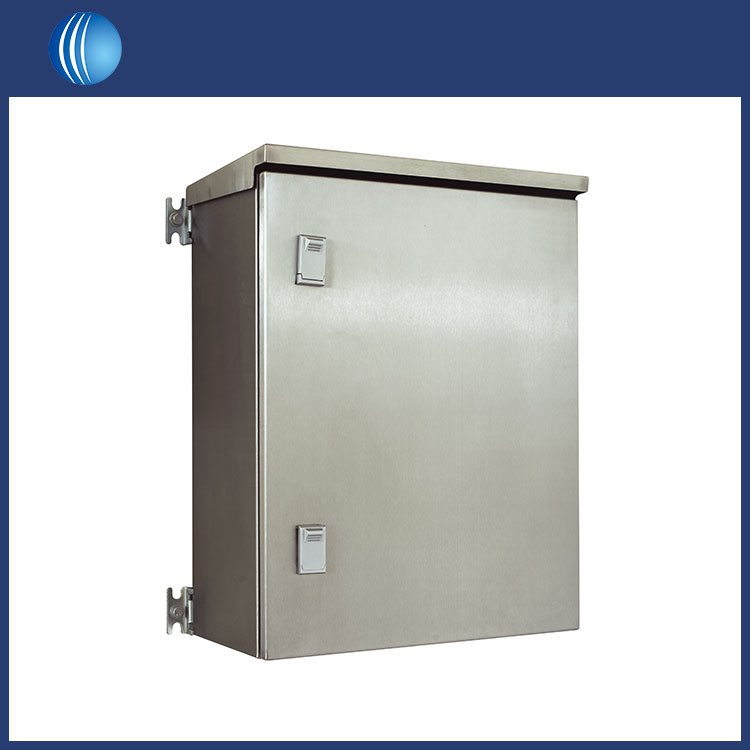
Cold-rolled steel is the most widely used basic material for industrial enclosures, offering excellent cost-effectiveness. It has uniform material properties, high strength, and is easy to stamp and bend. It can be customized to different thicknesses and shapes as needed. After surface treatment such as spraying and electroplating, it can provide a certain degree of rust and corrosion resistance, and its cost is far lower than stainless steel and aluminum alloy.
Industrial enclosures Commonly used models are 304 and 316 stainless steel. 304 stainless steel has good resistance to atmospheric and freshwater corrosion, while 316 stainless steel, with the addition of molybdenum, has stronger resistance to acids, alkalis, and seawater corrosion, as well as high mechanical strength and resistance to deformation, resulting in a long service life. Its disadvantages include higher cost, greater processing difficulty, and heavier weight, which is unfavorable for equipment handling and installation.
Aluminum alloy material also providing a certain level of protection. Its density is only about one-third that of steel, making it lightweight and easy to handle, install, and deploy outdoors. It also has good thermal conductivity, which helps dissipate heat from internal components. After anodizing the surface, its rust and corrosion resistance are significantly improved, and its appearance and texture are also superior. The disadvantages are that its mechanical strength is lower than that of steel and stainless steel, its impact resistance is weaker, and it is prone to deformation from prolonged heavy impacts. Its cost is also higher than cold-rolled steel plates.
Engineering plastics commonly used materials include ABS, PC, and nylon. They have excellent insulation properties, effectively preventing electric shock risks, and are resistant to acids, alkalis, and organic solvents. They are lightweight, easy to process, and moderately priced, and possess a certain degree of toughness, with better impact resistance than brittle materials like glass.Applicable scenarios mainly include equipment requiring high insulation and operating in mild environments (without strong impacts or high temperatures).
In summary, the selection of industrial enclosures materials requires a comprehensive assessment based on four core dimensions:
First, the working environment, to determine the priority of material protection; second, equipment requirements, considering equipment weight, internal component heat dissipation needs, and insulation requirements to select materials with matching strength, thermal conductivity, and insulation properties; third, processing and installation, considering the complexity of the enclosure structure and the difficulty of handling and installation, while also considering the material's processability and lightweight requirements; and fourth, cost budget, balancing material cost and equipment service life while meeting protection and usage requirements, avoiding over-selection or under-selection.